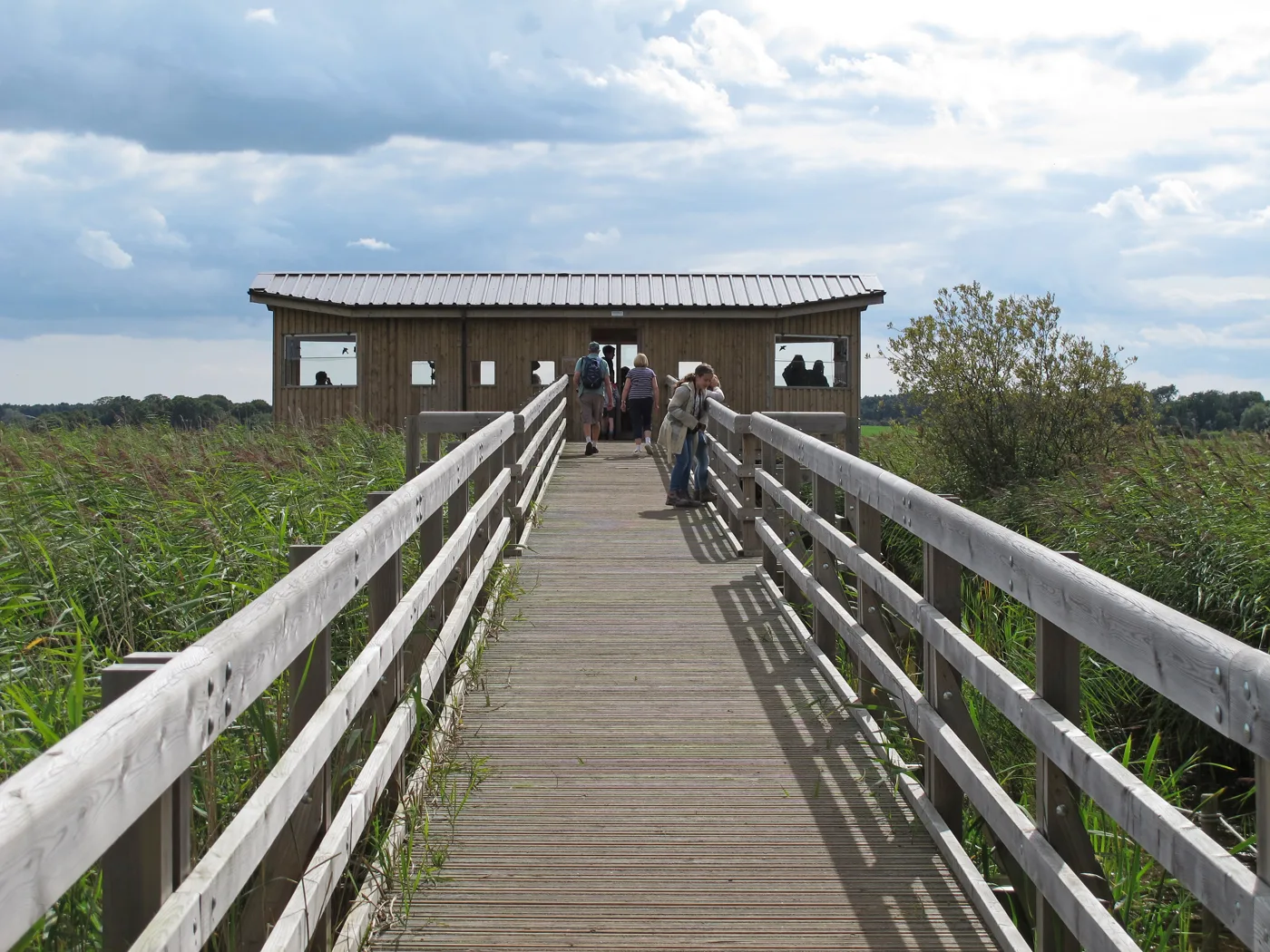

East Suffolk approved the rebuild of Minsmere's Island Mere hide ramp on 10 September, with wheelchair passing places and a second pond-dipping platform.
East Suffolk Council has approved RSPB Minsmere’s plan to rebuild the access ramp to the Island Mere hide and the structures around its pond-dipping area. The decision was issued on Thursday 10 September, under reference DC/26/2184/FUL.
The existing ramp, bridge and platforms have reached the end of their working life. What makes this more than a like-for-like replacement is what the RSPB has changed in the redesign.
The council’s landscape officer set out the changes in the case file:
- passing and viewing places designed into the ramp and boardwalk, for mobility scooter, wheelchair and pushchair users
- a second pond-dipping platform, alongside the existing one
- a rebuilt pond bridge, standing about 1 metre above the water at most
- an Island Mere hide ramp about 5 metres high at its tallest point, close to the hide entrance
The second dipping platform is not only about crowding. The officer report says having two lets one platform and its stretch of pond be left fallow, so the same water is not disturbed continually by visiting groups.
What was approved
Both the ramp and the pond bridge and platform will be built in timber, on substructures of dark brown recycled plastic lumber. The council’s landscape officer said the timber will weather down to blend into the reserve while the recycled plastic keeps the substructure sound for a long time.
Why it matters at Minsmere specifically
Minsmere is a 1,000-hectare reserve, managed by the RSPB since 1947, and in its application the charity puts its own visitor figure at more than 80,000 a year. The same letter describes the reserve as a significant part of the Suffolk coast tourism economy and lists its recent recognition, including a VisitEngland Gold Award and a place on the Birdwatch Magazine Birders’ Choice awards. Those are the RSPB’s claims, made in its covering letter to the council.
The reserve already has an Access For All path, which the council’s National Landscape officer called a very successful addition. The new structures are described in the case file as building on that, opening up more of the reserve to visitors with different access needs.
The RSPB’s own covering letter says the work will support “inclusive access for visitors, including those with limited mobility and families with pushchairs”, and improve the facilities used for guided family pond-dipping sessions in the school holidays.
Nobody objected, and here is what the consultees said
The application drew no third-party comments at all, and no objection from a single statutory consultee.
- Westleton Parish Council agreed at its meeting on 27 July that it had no objection.
- The Suffolk Coastal Disability Forum wrote that it “fully supports these improvements to further enhance RSPB Minsmere for disabled visitors and staff”.
- Natural England raised no objection.
- The Environment Agency said the proposal is minor in scale and water-compatible, so the absence of a site-specific flood risk assessment was not a constraint.
- Suffolk County Council’s rights of way team said it did not wish to restrict permission, as the work does not harm the public right of way network.
- Suffolk Wildlife Trust and the county archaeological unit did not reply.
The ecology condition, and why it was needed
Building anything at Minsmere is not straightforward. The site is a Site of Special Scientific Interest, a Special Area of Conservation, a Special Protection Area and a Ramsar wetland, and it sits in flood zones 2 and 3.
The RSPB submitted a shadow Habitats Regulations Assessment identifying four risks: noise and vibration disturbing birds during construction, trampling or cutting back of habitat, pollution from machinery, and extra disturbance later from increased use.
The council’s ecology officers accepted that those can be mitigated, so no full Habitats Regulations Assessment was required. Instead the permission carries a condition tying the work to a Construction Environmental Management Plan, which the RSPB filed on 7 September, three days before the decision. The development does not require mandatory biodiversity net gain.
The application was decided by officers under delegated powers rather than by councillors, because it triggered none of the council’s referral or committee thresholds. The case officer was Nick Clow and the decision was authorised by senior planner Jamie Behling. The statutory deadline was 9 September and the council agreed an extension to 11 September with the applicant.
What it means for you
Nothing changes at the reserve yet. Permission lasts three years, so work must start by 10 September 2029, and the RSPB has not published a start date.
When it does happen, expect the Island Mere hide approach and the pond-dipping area to be closed or restricted while the structures are replaced. The Construction Environmental Management Plan condition means the timing will be shaped by the breeding season as much as by the builders.
If you are planning a visit in the meantime, the reserve’s roads are worth checking first: several of the lanes between the A12 and this stretch of coast are closed or under night closures for Sizewell C, and the B1125 shuts completely from 9 November to 1 March. Current position: Suffolk coast roadworks and travel.
Sources
- Application DC/26/2184/FUL, East Suffolk Council planning register, including the delegated report of 10 September 2026, the decision notice, the RSPB’s covering letter and the consultee responses
- Dates, conditions and the determination route are taken from the council’s own delegated report and decision notice for that reference
- More planning decisions across the district: East Suffolk planning news
Have your say